The Infrastructure AI Can't Build
Published on June 19, 2026 | 4 min read
Two leaders from the same statewide organization sat at the same table during a Vision to Matter session. Afterward, one said it was the most time they had ever spent together — actually knowing each other, thinking together, building strategy together. That sentence reveals the missing ingredient behind every AI project that hits a wall.
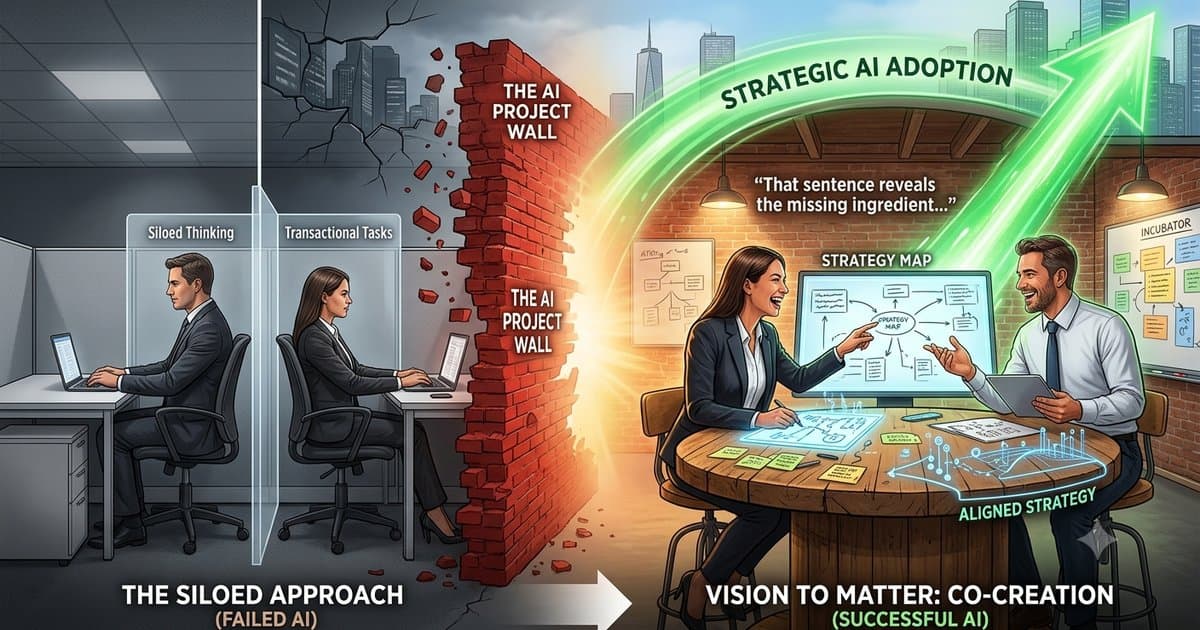
Two leaders from the same statewide organization sat at the same table during a Vision to Matter session last month. They had worked together for years — exchanged hundreds of emails, sat through dozens of meetings, represented the same mission on the same stages. After the session, one of them said something that should stop every executive team in the country: it was the most time they had ever had together. Actually getting to know each other. Actually thinking together. Actually building strategy together.
The Real Reason Transformations Stall
The research on AI adoption failure is consistently framed as a technology problem. It is not. 95% of companies fail to achieve meaningful ROI from AI initiatives within six months, and the primary barriers are organizational, not technical. MIT identifies three root causes: misaligned goals, unclear ownership, and unchanged workflows. None of those are problems a better model solves.
58% of leaders identify disconnected governance as the primary obstacle preventing them from scaling AI responsibly. The word “governance” sounds like a compliance issue. It is not. It is a trust issue. You cannot govern what you cannot agree on. You cannot agree on what you have never actually discussed. And real discussion requires time that most leadership teams have never made.
The two leaders at that table are not an anomaly. They are the norm. Most executive teams co-exist more than they collaborate. They move fast, in parallel, rarely slowing down long enough to know how the person across the table actually makes decisions — what they fear, what they protect, what they would trade.
What the Science Actually Shows
Amy Edmondson's foundational research established psychological safety as the single strongest predictor of team performance. Not because people need to feel good. Because without safety, no one brings their real thinking into the room. They manage appearances instead of problems. They perform alignment instead of building it.
The data on intentional leadership time is consistent. Pre- and post-event surveys show 15–30% improvements in employee engagement following structured facilitated experiences. Teams using structured alignment processes achieve 42% higher success rates and significantly better agreement on direction. These are not soft metrics. They are the precondition for every hard metric that follows.
The most important infrastructure a leadership team can build is not in any software. It's the shared understanding of who each leader actually is — their non-negotiables, their decision patterns, their values when the pressure is on.
That infrastructure does not come from a Slack channel or a quarterly all-hands. It comes from time. Intentional, structured, purposeful time — designed to surface the things that make strategy real rather than aspirational.
The Missing Ingredient Is Not a Tool
45% of CEOs report that employees are reluctant or hostile toward AI adoption. That gets read as a communication problem or a change management problem. It is simpler than that: people do not trust a direction they do not understand, and they do not understand a direction that leadership itself has not aligned on. The workforce is reflecting the leadership team back at itself.
When two leaders from the same organization have never had space to actually think together, what chance does their team have of believing the organization knows where it is going? The AI project does not stall at the technology layer. It stalls in the space between what leadership said and what they actually believed.
Every transformation that has stalled — AI or otherwise — stalled in the gap between what leaders said they agreed on and what they had never actually discussed. Closing that gap is not a retreat activity. It is the foundational work that makes everything else possible.
The Space Is the Strategy
Making intentional space for leaders to know each other is not a precursor to the real work. It is the real work. An aligned leadership team moves faster, decides cleaner, and builds organizations that can hold a direction through the noise of any transformation. A misaligned one produces exactly what most AI initiatives produce: impressive pilots, sluggish adoption, and a wall at six months.
The moment at that Orion Growth session — two leaders realizing they finally knew each other — was not a side effect of the facilitation. It was the design. Vision to Matter is built to surface identity, surface values, and create the conditions where real strategy becomes possible because the people building it actually trust each other.
If your organization is heading into a transformation — or trying to understand why the last one lost momentum — the alignment conversation belongs before the technology conversation. Explore Vision to Matter Sessions to learn how we create that space for leadership teams across Charlotte, Lake Norman, and beyond.