Your Brain Isn't Ready (But It Can Be): The Neuroscience of Thriving in the AI Age

13 min readAI Strategy
NeuroplasticityAI StrategyBehavioral ScienceCharlotte BusinessDavidsonWorkforce TrainingCognitive AdaptationHuman-AI Collaboration
Your Brain Isn't Ready (But It Can Be): The Neuroscience of Thriving in the AI Age

Creative thinking dropped 30% in 5 years as AI became ubiquitous. But neuroplasticity research reveals the uncomfortable truth: Your brain is already rewiring itself every time you interact with AI. The question isn't whether AI will change human consciousness—it's whether you're choosing how that evolution happens. Charlotte businesses have a unique advantage in this transformation, with UNC Charlotte's AI Institute and state-level AI leadership creating ideal conditions for intentional human-AI symbiosis. Discover the brain-centered approach to AI adoption that preserves judgment while amplifying capabilities.

The Uncomfortable Truth About Your Brain and AI

Here's what nobody's telling you: Your brain isn't fixed. It never was.

Every time you check your phone, scroll through feeds, or ask AI to do something you used to struggle with, you're rewiring your neural pathways. Not metaphorically. Literally.

The question isn't whether AI will change how humans think—that's already happening. The real question is whether you're choosing how your brain adapts, or letting algorithms make that choice for you.

In Charlotte, where nearly 7,000 job postings now require AI skills, business leaders face a startling reality: technical training isn't enough. The real competitive advantage lies in understanding how the human brain learns, adapts, and evolves in the presence of intelligent machines.

Neuroplasticity Isn't New—But Its Urgency Is

Your brain has approximately 86 billion neurons, each capable of forming thousands of connections. Neuroplasticity—the brain's ability to reorganize itself—continues throughout your entire life, not just childhood.

This isn't some motivational fluff. It's measurable neuroscience.

Recent 2025 research shows that while children's brains adapt through passive exposure, adults need intentional engagement—deliberate practice with reading, socializing, or learning new skills—to trigger neuroplastic changes.

The AI age demands this intentionality at scale.

The Neuroplasticity Formula for AI Adaptation

Passive Exposure + Intentional Engagement = Neural Rewiring

  • Passive: Using AI tools without understanding them
  • Intentional: Deliberately learning how AI works and why it responds the way it does
  • Result: Your brain builds new pathways that amplify (not replace) human judgment

The Charlotte Case: Where Banking Meets Brain Science

Charlotte isn't just a banking center anymore. It's becoming a testing ground for human-AI collaboration at scale.

UNC Charlotte's new AI Institute launched with a specific mission: prepare the next generation of AI professionals while serving as a hub for interdisciplinary research. Meanwhile, North Carolina's AI Leadership Council includes Charlotte's Chief Information Officer, signaling state-level commitment to becoming "the most AI-literate state in the nation."

But here's where it gets interesting for business.

In Charlotte's finance sector, banks and insurers are competing for program managers and organizational change management leaders who can guide transformation efforts. Not just technical leads. Change management experts.

Why? Because the limiting factor in AI adoption isn't technology. It's the human brain's capacity to adapt to rapidly shifting work patterns.

What Science Reveals About Learning in the AI Age

Let's get specific about how your brain actually works when learning something new—and why this matters more than ever.

The Three-Stage Learning Process

StageBrain ActivityAI Age Challenge
1. Cognitive PhaseHigh mental effort, slow performance, frequent errorsAI can skip this for users, preventing learning
2. Associative PhasePattern recognition develops, errors decrease, connections formAI patterns differ from human patterns—requires conscious integration
3. Autonomous PhaseAutomatic execution, minimal cognitive load, masteryRisk of "learned helplessness" if AI always provides answers

Research on neural reshaping demonstrates that machine learning models enhance performance through iterative learning and optimization—drawing direct parallels to human neuroplasticity in strengthening and adjusting connections.

But there's a critical difference: AI systems undergo "techno-plasticity" (real-time self-modifications), while human neuroplasticity requires biological adaptation over time.

Translation: AI learns faster than you. That's not a problem—it's a design feature. If you understand how to leverage it without atrophying your own cognitive capabilities.

MIT's Groundbreaking "Your Brain on ChatGPT" Study

In June 2025, MIT Media Lab released a landmark study that should fundamentally change how we think about AI adoption in the workplace.

Using electroencephalography (EEG) to track brain activity, researchers divided participants into three groups: ChatGPT users, search engine users, and "brain-only" writers who used no external tools. Over four months and multiple writing sessions, they measured neural connectivity, memory recall, and learning outcomes.

The results were stark:

  • 55% lower cognitive engagement in the ChatGPT group compared to unaided writers
  • 83% of ChatGPT users couldn't recall key points from their own essays
  • Zero accurate quotes — none could provide exact quotes from papers they'd just written
  • Reduced alpha and beta brain connectivity, indicating systematic under-engagement
  • Scaled cognitive atrophy: Brain-only group showed strongest neural networks, search engine users showed intermediate engagement, and LLM assistance produced the weakest overall brain coupling

⚠️ Critical Finding: Cognitive Debt Accumulation

MIT researchers discovered that students using ChatGPT showed lower brain activity, weaker memory recall, and less ownership of their writing. Their essays were well-structured and grammatically polished, but they learned and retained less.

The paradox: Higher output quality, lower learning retention. Better immediate results, worse long-term capability building.

Note: As of June 2025, this paper is a preprint and has not yet been peer-reviewed. However, its findings align with broader neuroplasticity research and have sparked global media coverage in CNN, Nature, CBS News, The New Yorker, USA Today, and Time.

But here's the crucial insight that Charlotte businesses need to understand: Those who used their own cognitive skills earlier showed improved performance when later given AI support.

This means the sequence matters. Build human capability first, then amplify with AI. Not the reverse.

MIT CSAIL: Brain-Inspired AI Models

Meanwhile, MIT's Computer Science and Artificial Intelligence Laboratory (CSAIL) is taking the opposite approach: making AI more like human brains.

Researchers developed "closed-form continuous-time" (CfC) neural networks and "linear oscillatory state-space models" (LinOSS) that leverage principles of forced harmonic oscillators observed in biological neural networks. These models are flexible, causal, robust, and explainable—but orders of magnitude faster and more scalable than traditional approaches.

The implication? AI itself is becoming more neuroplastic, more adaptable, more brain-like. This creates both opportunity and urgency: as AI adopts human-brain principles, humans must consciously maintain the cognitive capabilities that make us valuable partners to these systems.

Wait—what does neurodiversity have to do with AI adaptation?

Everything. Because AI-powered tools are inherently accommodating to different cognitive styles. AI-powered task chunking apps reduce missed deadlines by 55% for employees with ADHD.

This reveals something profound: The businesses that will thrive aren't those with "AI strategies." They're the ones that understand how different human brains interact with AI differently—and design work systems accordingly.

The Behavioral Science Behind Sustainable Change

Tony Robbins built an empire on Neuro-Associative Conditioning (NAC), which leverages brain plasticity to reprogram pleasure circuits and create new neural pathways.

Strip away the motivational speaking, and you find legitimate behavioral science principles:

  • Association: The brain creates connections between actions and outcomes (pain or pleasure)
  • Repetition: Neural pathways strengthen through consistent activation
  • Emotional intensity: Stronger emotions create stronger neural imprints
  • State management: Your physiological state affects cognitive performance and learning capacity

Academic analysis of NAC suggests that while many techniques derive from established research, claims about "immediate control" of mental and emotional destiny are overstated and raise ethical concerns.

But here's what is scientifically sound: Your brain responds to repeated patterns, emotional context, and deliberate practice.

In the AI age, this means your workforce isn't just learning new tools. They're rewiring their cognitive processes around collaboration with non-human intelligence.

⚠️ The Creative Thinking Decline

Creative thinking has dropped 30% in 5 years as AI tools become ubiquitous.

The good news: Just minutes per day of targeted creative practice shows measurable improvements in creative output. Creative thinking can actually improve throughout our lives if nurtured.

The implication: AI adoption without intentional creativity practice creates cognitive atrophy. Your team needs structured creative exercises, not just AI tool training.

Consciousness, Evolution, and the AI Partnership

Now we arrive at the deeper question: How does human consciousness itself evolve when paired with artificial intelligence?

Recent analysis of AI and human consciousness examines how sustained interaction with AI affects neural pathways, cognition, and behavior. The early findings are striking:

  • Attention span changes: Heavy tech users show measurable differences in attention span, multitasking abilities, and memory processing
  • Information processing shifts: Smartphones trained our brains to process information in quick bursts within just over a decade
  • Cognitive bias amplification: Social media algorithms create systematic cognitive biases on unprecedented scales, including "preference crystallization" where desires become narrow and predictable

This isn't science fiction. It's short-term evolutionary change happening in real-time.

The human brain's extraordinary plasticity enables acquisition of diverse skills, supporting cultural evolution and individual learning across contexts. This adaptability is precisely what allows us to integrate AI tools—but it also makes us vulnerable to unintended cognitive reshaping.

MIT McGovern Institute: Language, AI, and Brain Architecture

MIT's McGovern Institute research reveals something critical about how our brains process language versus reasoning—and why this matters for AI collaboration.

Using fMRI to study brain activity, researchers discovered that "in the brain, there is a language processing module and separate modules for reasoning." This modular architecture has profound implications: when we rely on AI for language generation, we're not just outsourcing words—we're potentially bypassing the neural pathways that connect language to higher-order thinking.

Meanwhile, MIT research on AI language models found that models performing well on next-word prediction show similarity to human brain function, offering evidence that the human brain may use next-word prediction to drive language processing.

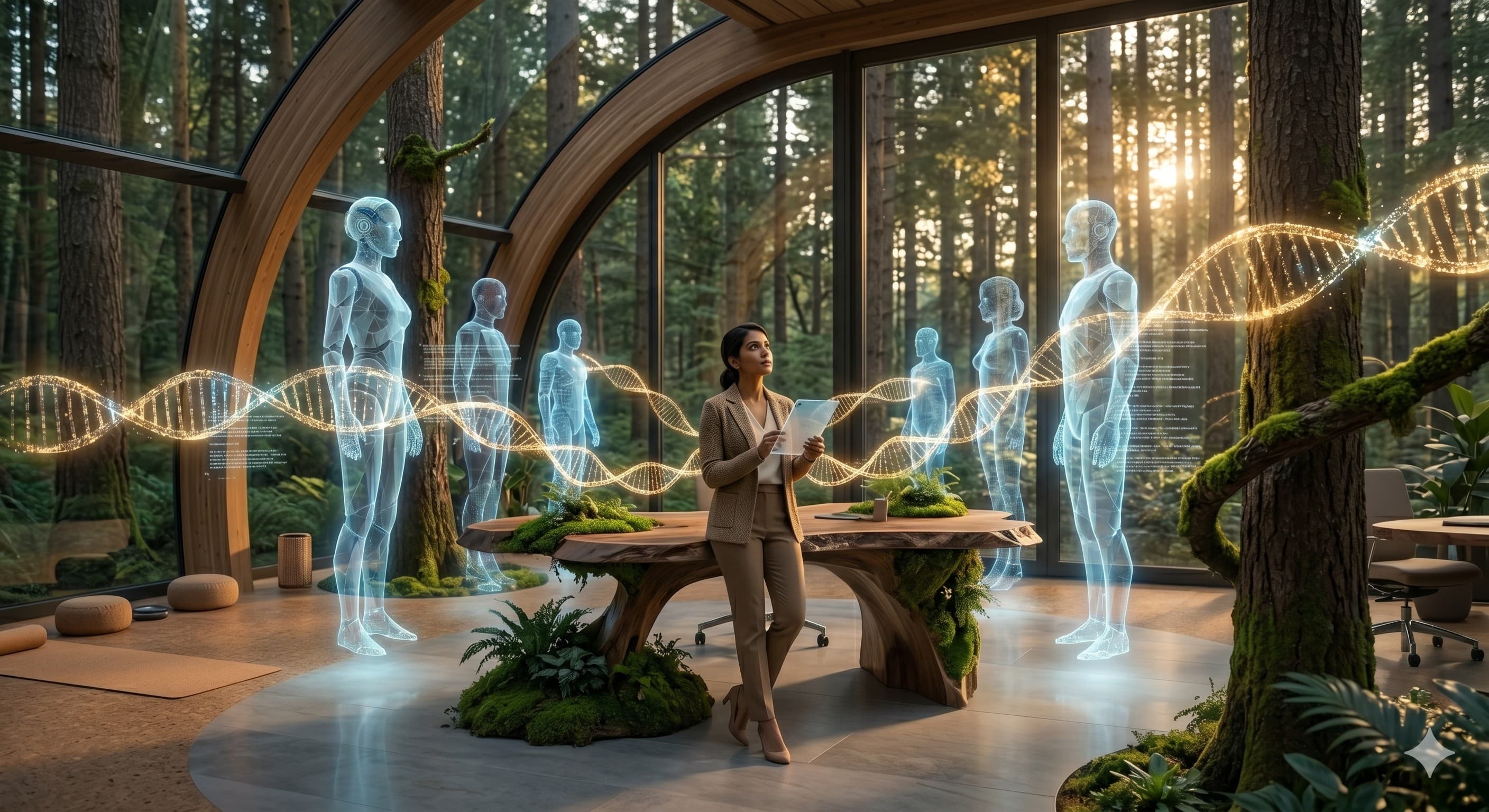
The convergence is striking: AI models are becoming more brain-like, while human brains are adapting to AI patterns. The question isn't whether this co-evolution happens—it's whether we're consciously directing it or letting it emerge accidentally.

🧠 MIT's Energy-Efficient Brain Computing Research

MIT researchers are developing neuromorphic computing that mimics the brain by processing and storing information in the same place, using electrochemical ionic synapses that can be tuned like neurons strengthening or weakening connections.

Why this matters: The brain consumes far less energy than training large AI models. As AI becomes more brain-like in efficiency, the competitive advantage shifts to humans who maintain cognitive fitness—because brains already run on ~20 watts while GPT-4 training consumed megawatts.

The Three Paths Forward

Businesses (and humans) now face three distinct evolutionary paths:

PathCharacteristicsOutcome
1. Cognitive OffloadingLet AI do all thinking, atrophy human judgment⚠️ Dependency, reduced problem-solving ability
2. AI ResistanceReject AI tools, maintain "pure" human cognition⚠️ Competitive disadvantage, market irrelevance
3. Intentional SymbiosisUse AI to amplify human strengths while maintaining cognitive fitness✅ Enhanced capabilities, preserved judgment, competitive advantage

Only the third path—intentional symbiosis—creates sustainable competitive advantage.

The Davidson/Charlotte Opportunity: Leading Regional AI Evolution

From our Davidson headquarters, we're watching Charlotte's business community navigate this transformation in real-time.

The advantages are clear:

  • Educational infrastructure: UNC Charlotte's AI Institute provides local access to cutting-edge research and talent pipelines
  • Banking sector expertise: Wells Fargo and Bank of America's early AI adoption creates knowledge spillover effects
  • State-level support: North Carolina's AI Leadership Council signals policy and resource commitment
  • Regional culture: Lake Norman's mix of established businesses and entrepreneurial energy creates ideal conditions for measured innovation

But the real opportunity isn't technological. It's neurological.

Charlotte businesses that understand how to train human brains to work with AI—not just how to deploy AI tools—will dominate their markets for the next decade.

Your 30-60-90 Day Brain-Centered AI Transformation

This isn't theory. Here's the practical roadmap for building neuroplasticity-aware AI adoption.

30-Day Quick Wins: Establish Neural Baselines

  • Week 1: Cognitive Self-Assessment
    • Document current workflows and decision-making processes
    • Identify tasks where you rely on pattern recognition vs. deep analysis
    • Track your attention span during focused work (use 25-minute Pomodoro cycles as baseline)
  • Week 2: Intentional AI Introduction
    • Choose ONE AI tool for a specific business function
    • Use it alongside your normal process (not as replacement) for two weeks
    • Journal how it changes your thinking, not just your output
  • Week 3: Creative Practice Protocol
    • Implement 15 minutes daily of "no-AI" creative thinking (brainstorming, problem-solving, strategy)
    • Then spend 15 minutes using AI on the same problem
    • Compare outputs and integration approaches
  • Week 4: Team Cognitive Mapping
    • Meet with each team member to understand their learning style and cognitive preferences
    • Identify neurodivergent team members who might benefit from AI accommodations
    • Create personalized AI adoption plans based on individual brain wirings

60-Day Strategic Implementation: Build Neural Pathways

  • Week 5-6: Structured Learning Sessions
    • Weekly 90-minute deep dives into how AI models work (not just how to use them)
    • Understanding mechanisms builds better mental models and reduces cognitive anxiety
    • Focus on pattern recognition: What does AI see that humans miss? Vice versa?
  • Week 7-8: Behavioral Change Integration
    • Apply NAC principles: Associate pleasure with correct AI usage, concern with cognitive offloading
    • Create team rituals around "AI + Human" decision-making (not either/or)
    • Celebrate moments where human judgment overrides AI suggestions (with good reason)
  • Week 9-10: Workplace Redesign
    • Modify physical and digital workspaces to support neuroplasticity
    • Create "deep work" zones free from AI interruptions
    • Establish "AI collaboration zones" optimized for human-AI pairing
    • Implement sensory modifications for neurodivergent staff (lighting, sound, layout)

90-Day Transformation: Achieve Intentional Symbiosis

  • Week 11-13: Advanced Integration Practices
    • Develop role-specific AI workflows that amplify (not replace) human expertise
    • Train teams to recognize when they're experiencing "learned helplessness" with AI
    • Establish metrics for cognitive health: attention span, creative output, decision quality
  • Week 14-16: Organizational Neuroplasticity
    • Create feedback loops where humans teach AI (fine-tuning, reinforcement learning)
    • This reverses the typical power dynamic and maintains cognitive engagement
    • Document cognitive improvements: faster learning curves, better problem-solving, enhanced creativity
  • Week 17-18: Cultural Embedding
    • Make "brain-centered AI adoption" part of hiring and onboarding
    • Share case studies of successful human-AI collaboration within the team
    • Partner with UNC Charlotte AI Institute for ongoing research collaboration

Expected Outcomes After 90 Days

  • Productivity gains: 25-40% efficiency improvement in AI-augmented tasks
  • Cognitive preservation: Maintained or improved creative thinking scores
  • Employee satisfaction: Reduced cognitive stress, clearer role definition
  • Competitive advantage: Faster decision-making with higher-quality outputs
  • Adaptability: Team demonstrates resilience to future AI changes

The Question That Matters

Will AI change human consciousness and evolution?

It already has.

The real question is: Will you guide that evolution intentionally, or let it happen by default?

Your brain is plastic. Moldable. Adaptable. That's both your greatest vulnerability and your strongest asset in the AI age.

Charlotte businesses have a unique moment: Geographic proximity to cutting-edge AI research, established corporate AI adoption patterns, and a regional culture that values both innovation and stability.

The businesses that win won't be those with the most AI. They'll be those that understand how to wire human brains and artificial intelligence into symbiotic partnerships—where each amplifies the other without diminishing either.

That's not a technical challenge. It's a neurological one.

And it's the difference between thriving and obsolescence in the next decade.

Ready to Build Brain-Centered AI Adoption?

At Holistic Consulting Technologies, we specialize in helping Charlotte and Lake Norman businesses navigate the intersection of neuroscience and artificial intelligence. We don't just implement AI tools—we design cognitive frameworks that preserve human judgment while amplifying capabilities.

Based in Davidson, NC, we understand the unique challenges facing regional businesses as they adapt to AI-driven transformation. Our approach combines cutting-edge AI strategy with research-backed neuroplasticity principles to create sustainable competitive advantages.